Automated Honing for Low to Mid-Volume Production
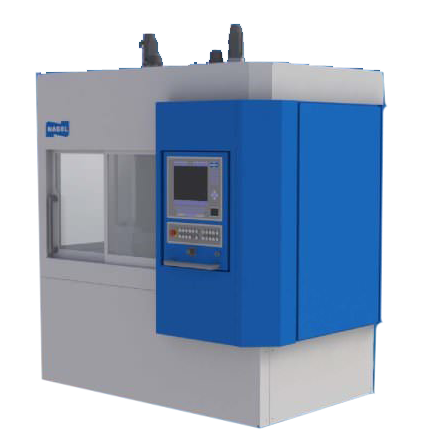
Nagel Precision Inc. (Ann Arbor, MI), a supplier of high-volume honing systems for the North American automotive industry, has introduced the ECO 40 flexible-stroke honing system to hold submicron bore sizes and produce mirror finishes in low-to-medium volume production applications.
Designed with automatic tool-wear compensation and form-error detection and correction capability, the system can have up to three honing and postprocess gaging stations, and finishes bore sizes from 3 to 40 mm. An automatic tool-wear compensation system is integrated into the postprocess gaging system and the honing spindle. Controlled by servos from Allen Bradley (AB; Milwaukee), the system monitors bore size on each part, and automatically compensates
for tool wear in all the honing stations by making fine submicron-level adjustments, ensuring bore accuracy.
This machine represents an advance over manual compensation systems. In a manual compensation system, the operator has to measure the finished bore frequently and manually compensate for tool wear. Over/under compensation is a common problem, leading to reduced control of bore size and excessive machine downtime, as the operator has to stop the machine frequently to compensate for tool wear.
The tool-wear compensation system minimizes noncutting time while improving bore quality. Once the tool is inserted in the bore, the tool expands at a rapid feed of 200 um/sec and at high torque (45% of available) until it reaches a pre-determined position close to the bore. It will then switch to a rapid stock-removal mode of about 4 um/sec at lower torques (15% of available torque) to avoid tool damage. Toward the end of the cycle, the expansion rate is reduced to about 2 um/sec, or 10% of the available torque. The system constantly monitors both the tool feed (p/sec) and the applied torque (as % of available). If the desired feed is not reached at the preset torque, the operator can either reduce the tool expansion rate (if tighter tolerances are desired) or increase the torque, if quicker cycle times are needed.
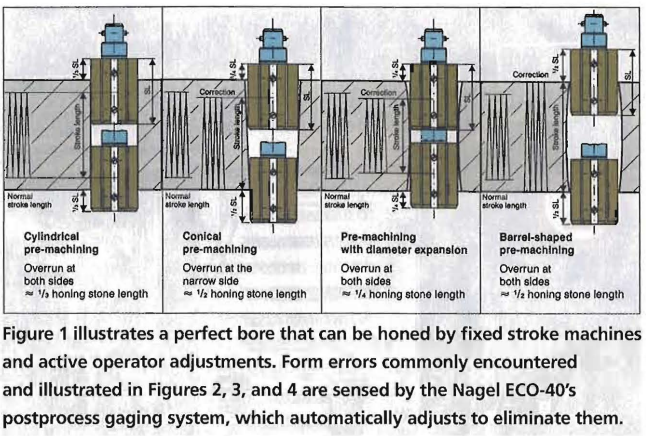
Tool expansion is rapid when there is no cutting, and is slowest for the final finishing cut, which results in a consistent bore in terms of finish, size, and cylindricity. Where there is form error, like taper, hourglass, barrel shape, ovality, or bend, the ECO 40 automatically senses the form error and makes adjustments to correct it.
Most machines on the market today have a fixed stroke (as illustrated in Figure I) that is designed to hone a perfect bore. Illustrated in Figures 2, 3, and 4, are form errors that are more commonly encountered. Some machines enable the operator to cause the machine to dwell for a longer time at the bottom of a blind bore, or program a different stroke length to correct these form errors. This adjustment, however, would require the operator to know the exact nature of the
inaccuracy coming in, and to generate a program to address that particular form error. The configuration will not be effective should the type of form error change. Hence it would require a skilled operator to inspect the incoming part and modify the stroking, which is not always feasible and could be time-consuming.
The ECO 40 is equipped with postprocess gaging that can sense the form error on each part, and make automatic stroke adjustments to correct it. The honing spindle and the stroking system are driven by AB servomotors. A compact, gear-driven index table enables part loading and unloading during the finishing operation. The system can either be fully automated or tended manually.