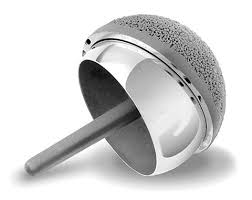
The aim of all honing operations, whether single pass or conventional stroke, is superfine finishes.
By Alan Richter
When honing a bore to achieve the specified size, surface finish and oil retention pattern, two options are available on dedicated honing machines: single pass or conventional stroke.
Single-pass honing is performed with one down stroke and return of a honing tool, said Dave Blakney, sales manager for Sidley Diamond Tool Co., Garden City, Mich., which manufactures honing machines, hones and other cutting tools. “It is typically only used in finishing applications. However, progressive stock removal can be done in our multi- spindle hone machines, which allow for more stock removal.”
Lapmaster Wolters
Common applications include cast iron valve bodies and gears. Single-pass honing is suitable for the vast majority of metals, including nonferrous ones, Blakney said.
The number of machine spindles varies, depending on the application. “We’ve built some single-pass machines with as many as 14 spindles,” said Rick Lundy, director of sales for the Barnes product line at Lapmaster Wolters LLC, Mount Prospect, III.
Done in One Single-pass honing is usually reserved for high-volume production—200 parts or more per hour, Lundy said, adding that one Lapmaster machine for producing connecting rods for air conditioning compressors had a cycle time of 6 to 7 seconds.
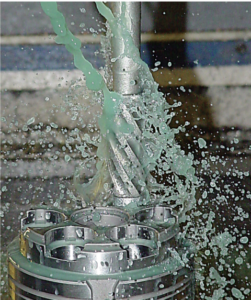
The single-pass diamond tool is a conical- shaped mandrel, said Sanjai Keshavan, man- ager of the ECO hone and microfinishing systems division for Nagel Precision Inc., Ann. Arbor, Mich. Once a single-pass hone enters a part bore, the bore size equals the tool diameter.
Keshavan said most tools used are made of plated diamond abrasive and that he refers to the process as “diamond sizing.” He added that CBN hones are applied to hardened materials those as hard as 58 to 62 HRC-in connection with traditional stroke honing to help prevent generating microcracks in the workpiece, which diamond sizing of hard materials can cause.
The decision to single-pass hone is driven by the requirement for a part’s overall cycle time, according to Michael Schaefer, director of sales and R&D for Gehring LP, Farmington Hills, Mich.
“If the customer needs a part coming off the machine every 45 seconds, then we would probably go to single-pass honing and just have two or three or four passes to remove all the [specified] mate- rial,” Schaefer said, noting that 80 to 90 percent of Gehring’s applications are for conventional-type honing machines and tools. “At a certain point, it becomes a question of investment, because you need more spindles to remove the same amount of material with single-pass versus stroke honing.”
Generating a Crosshatch
To remove more material with one tool in one operation, parts manufacturers turn to conventional stroke honing, Schaefer said. Most of his company’s stroke-honing machines have two or three spindles, wherein each spindle removes a different amount of material during roughing, semifinishing and finishing processes to create the specified shape and surface finish.
Stroke honing is effective for generating a cross-hatch pattern in a cylindrical bore to retain oil and reduce friction. A hone creates the pattern as it moves up and down in the bore, in combination with an oscillating motion and rotating spindle, Keshavan said.
Schaefer added that adjusting the hone’s stroke speed and rotational speed changes the cross- hatch angle. A specific crosshatch angle is required to optimize friction. In an internal-combustion engine, for example, that optimization reduces fuel consumption and, therefore, CO2 emissions.
“Sometimes we need to get more lubrication or less lubrication to a part,” Schaefer said. “For most applications, we do research and development with our customers to define the perfect surface finish and geometry combination.”
Gehring’s honing tools and machines can produce a part with geometric features as accurate as 0.6μm, Schaefer added. “If you take that part and hold it for a second in your hand, just the temperature of your fingers will distort the part and make it out of spec.”
When honing a bore to the required specifications, stroke honing can be more effective than single-pass honing.
Honing Out Of Round
Gehring Technologies GmbH developed a process called form honing for the bores in an internal-combustion engine.
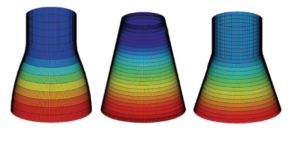
Instead of being given a cylindrical shape, like other engine bores, a form- honed bore is noncylindrically shaped. During operation, the form-honed bore assumes a cylindrical shape.
“We can create specific shapes, specific tapers, valleys, bottlenecks or whatever the custom might need in their part,” said Michael Schaefer with Gehring LP.
The company subdivides form honing into two process variations: light and professional.
Form honing light simulates thermal distortion by creating different tapered shapes. The thermal expansion-due to the higher taper in the top dead center-leads to a cylinder bore that must be honed to a smaller size at the top and a larger size at the bottom. Therefore, the piston sleeve has less contact with the bore, resulting in significantly less friction.
Form honing professional not only optimizes the local piston clearance, but also compensates for cylinder deviations. from static and thermal distortions. This capability means round and straight bores can be achieved in running conditions. In addition, ring tension is reduced, resulting in adaptive friction and CO2 reductions.
Examples of variations of functional shapes produced with form honing.
Each process requires special honing tools.
Since installing the first form honing system about 18 months ago, Schaefer
said Gehring has installed Gehring eight more. “So far this year, we’ve already received purchase orders for 17 additional systems,” he said, noting the price tag for each is about $3 million to $4 million.
Schaefer added that after the company directed a significant amount of development activities toward large-scale production, Gehring has entered stage two of development. This stage downsizes the technology so even job shops can apply it in single-spindle machines.
-A. Richter