
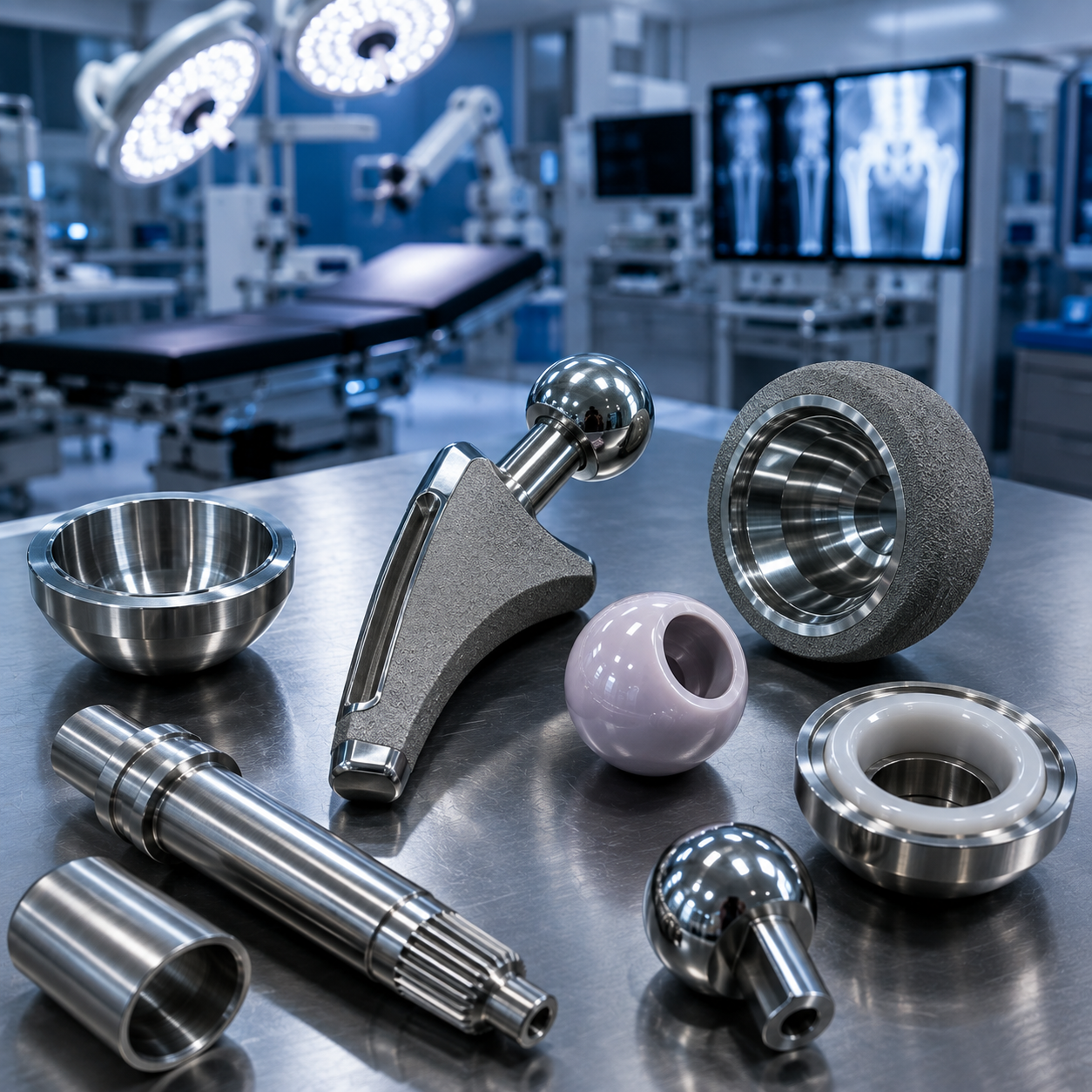
Medical Device Honing and Superfinishing Solutions
Nagel Precision provides advanced honing, superfinishing and precision surface finishing technologies for medical device and orthopedic component manufacturing, helping manufacturers achieve the dimensional accuracy, surface quality and repeatability required for today's precision medical components.
Nagel Precision provides advanced honing, superfinishing and precision surface finishing technologies for medical device and orthopedic component manufacturing, helping manufacturers achieve the dimensional accuracy, surface quality and repeatability required for today's precision medical components.
Medical Device Honing and Superfinishing Solutions
Nagel Precision provides advanced honing, superfinishing and precision surface finishing technologies for medical device and orthopedic component manufacturing, helping manufacturers achieve the dimensional accuracy, surface quality and repeatability required for today’s precision medical components. From hip and knee replacement components to bone screws, spinal implants, surgical instruments and precision medical bores, Nagel technologies can help manufacturers control the critical final surfaces that influence component performance.
Medical components are frequently manufactured from challenging materials including titanium and titanium alloys, cobalt-chromium alloys, stainless steels and other high-performance medical-grade metals. These materials are selected for strength, corrosion resistance, wear characteristics and biocompatibility, but they can present significant machining and finishing challenges.
Nagel combines advanced machine systems, tooling, abrasives, process development, measurement and automation to create precision finishing processes engineered around the component, material and required surface characteristics.
1. Hip Replacement & Orthopedic Implant Components
Hip replacement systems contain highly engineered components that must operate reliably under repeated loading and movement. Femoral components, stems, modular connections and other metallic implant surfaces require precise geometry and carefully controlled surface characteristics.
Nagel honing and superfinishing technologies can provide medical component manufacturers with precision processes for improving dimensional accuracy, roundness, cylindricity, surface finish and microgeometry on suitable orthopedic component surfaces.
Superfinishing is particularly valuable when manufacturers need to remove microscopic surface irregularities remaining from previous machining or grinding operations. Rather than simply producing a visually polished surface, the objective is to create a controlled functional surface based on the requirements of the component.
Depending on component design and application, precision finishing can help manufacturers achieve:
- Extremely low surface roughness
- Improved roundness and cylindricity
- Controlled surface characteristics
- Improved dimensional consistency
- Removal of microscopic surface peaks
- Repeatable component geometry
- Improved mating surfaces
- Consistent production quality
For manufacturers producing high-value orthopedic components, controlling the final microns can be just as important as the primary machining operation.
2. Knee Replacement & Joint Replacement Components
Modern knee replacement systems incorporate complex metallic components manufactured to precise dimensional and surface specifications.
Femoral components, tibial components, stems, extensions, sleeves and other orthopedic implant parts may require different surface conditions depending on where and how the component functions. Some surfaces may require extremely smooth finishes, while others may require specific geometries or controlled surface characteristics for assembly and interaction with adjoining components.
Nagel superfinishing technology provides manufacturers with a highly controlled process for improving functional surfaces after conventional machining or grinding.
For precision orthopedic components, these processes can contribute to:
- Reduced surface roughness
- Improved surface uniformity
- Controlled component geometry
- Improved mating surfaces
- Removal of machining irregularities
- Consistent surface characteristics
- High production repeatability
- Precision finishing of difficult materials
The ability to engineer the finishing process around the actual function of the surface makes honing and superfinishing valuable technologies for increasingly sophisticated orthopedic implant manufacturing.
3. Titanium & Cobalt-Chromium Medical Components
Material selection presents one of the greatest challenges in medical component manufacturing.
Titanium alloys, cobalt-chromium alloys and medical-grade stainless steels provide properties needed for many implantable and surgical applications, but those same properties can make these metals challenging to machine and finish consistently.
Titanium is valued for its strength-to-weight ratio, corrosion resistance and widespread use in implantable medical applications. Cobalt-chromium alloys offer exceptional strength and wear characteristics and are commonly associated with orthopedic joint components. Stainless steels remain important materials for surgical instruments, medical devices and selected implant applications.
Nagel’s precision finishing expertise provides manufacturers with processes that can be developed around specific combinations of material, component geometry, dimensional tolerance and required surface condition.
Depending on the application, Nagel technologies can help manufacturers achieve:
- Precision finishing of difficult-to-machine alloys
- Controlled material removal
- Improved dimensional accuracy
- Reduced surface roughness
- Improved microgeometry
- Repeatable surface characteristics
- Consistent component-to-component quality
- Automated finishing processes
Rather than treating every medical metal identically, the finishing process can be engineered around the characteristics of the material and the functional requirements of the component.
4. Medical Screws, Bone Screws & Spinal Fasteners
Orthopedic and spinal procedures rely on a wide variety of bone screws, pedicle screws, fixation screws, pins, rods and specialized medical fasteners.
Although these components can be physically small, their manufacturing requirements can be extremely demanding. Threads, shafts, transitions, bearing areas and other functional surfaces must be produced consistently while maintaining the geometry and surface requirements established for the component.
Nagel superfinishing technology offers potential solutions for appropriate rotationally symmetrical medical components where manufacturers need to improve surface characteristics after turning, grinding or other machining processes.
Precision finishing can help manufacturers pursue:
- Reduced surface roughness
- Removal of microscopic machining peaks
- Improved shaft surface quality
- Controlled component geometry
- Consistent finishing along cylindrical surfaces
- Repeatable component-to-component quality
- High-volume process capability
- Automated finishing operations
Centerless superfinishing technologies can be particularly useful for appropriate cylindrical components that can be processed continuously rather than individually positioned for every finishing operation.
For manufacturers producing thousands or millions of precision medical fasteners and similar components, this combination of precision and production efficiency can become a significant manufacturing advantage.
5. Spinal Implants, Rods, Pins & Precision Components
Spinal systems incorporate an expanding range of precision components, including spinal rods, pins, connectors, fixation components, screws, sleeves and other metallic implant components.
These components frequently combine complex geometry with demanding dimensional and surface requirements. Depending on the component, manufacturers may need to control diameter, straightness, cylindricity, roundness, roughness and other functional surface characteristics.
Nagel honing and superfinishing technologies provide manufacturers with additional options for controlling these characteristics during the final stages of production.
For cylindrical spinal components such as rods and pins, superfinishing can improve the functional surface following conventional machining or grinding. For components containing precision internal diameters, honing can provide highly controlled bore geometry and surface structure.
Nagel technologies can help manufacturers address:
- Precision cylindrical surfaces
- Small and demanding bore geometries
- Controlled internal diameters
- Improved roundness and cylindricity
- Reduced surface roughness
- Consistent component geometry
- Repeatable finishing processes
- High-value component manufacturing
As spinal implant designs continue to become more sophisticated, the ability to engineer both external and internal functional surfaces becomes increasingly valuable.
6. Surgical Instruments & Robotic Surgery Components
Medical manufacturing extends far beyond implantable components.
Surgical instruments, robotic surgical systems and advanced medical equipment contain numerous shafts, pivots, sleeves, guides, joints, bearing surfaces and precision bores that must operate smoothly and consistently.
As surgical technology becomes increasingly sophisticated, these mechanical components can require levels of dimensional control similar to those found in aerospace and other high-precision industries.
Nagel honing technology can be used to improve internal geometry and surface condition where components contain precision bores. Superfinishing can be applied to appropriate shafts, bearing surfaces and rotational components requiring controlled microgeometry and reduced roughness.
Potential manufacturing benefits include:
- Precise internal diameters
- Improved bore geometry
- Reduced surface roughness
- Improved shaft and bearing surfaces
- Controlled mating components
- Smooth mechanical movement
- Improved dimensional consistency
- Repeatable production quality
These capabilities can support manufacturers producing traditional surgical instruments as well as increasingly complex robotic and computer-assisted surgical equipment.
7. Precision Medical Bores, Sleeves & Tubular Components
Honing is especially valuable when a medical component contains a bore whose diameter, roundness, cylindricity, straightness or surface structure cannot be adequately controlled through drilling, boring, reaming or grinding alone.
Nagel develops precision honing systems and tooling capable of addressing a wide variety of bore sizes, geometries and materials.
Potential medical applications can include precision sleeves, instrument components, pump components, valve bodies, guides, cylinders, tubular components and other medical device parts containing critical internal diameters.
Nagel honing technologies can help manufacturers achieve:
- Tight bore diameter control
- Improved roundness
- Improved cylindricity
- Improved straightness
- Controlled surface roughness
- Repeatable internal geometry
- Precision finishing after heat treatment
- Consistent production results
Nagel can also develop specialized tooling and processes for challenging bore conditions, including blind holes, interrupted bores, cross holes and grooves.
For medical device manufacturers, this ability to engineer the machine, honing tool, abrasive and process around a specific bore provides an important alternative when conventional machining processes reach their practical limits.
8. High-Precision Medical Manufacturing & Automated Production
Medical manufacturing increasingly requires manufacturers to combine exceptional precision with documented, repeatable production processes.
A component may be physically small, but its value can be significant. Scrap, inconsistent surface quality and uncontrolled process variation can therefore become expensive manufacturing problems.
Nagel approaches precision finishing as a complete process rather than simply supplying a machine. Depending on the application, a manufacturing solution can integrate honing, superfinishing, specialized tooling, abrasives, measurement, process monitoring, automation and component handling.
This approach can be particularly valuable for manufacturers transitioning a medical component from development into repeatable production.
Nagel technologies can help medical manufacturers pursue:
- Consistent dimensional accuracy
- Repeatable surface quality
- Reduced process variation
- Automated component handling
- In-process or post-process measurement
- Reduced dependence on manual finishing
- Increased manufacturing efficiency
- Scalable production processes
Whether the requirement involves a high-volume medical fastener or a high-value orthopedic component, the objective remains the same: develop a controlled manufacturing process capable of repeatedly producing the required geometry and surface.
Precision Surface Finishing for Medical Device Manufacturing
Medical components often operate at the intersection of advanced materials, complex geometry and extremely demanding surface requirements. Producing the basic shape of a component is only part of the manufacturing challenge. The final surface can determine how components fit together, move, carry loads and perform within the finished medical device.
Nagel Precision provides medical device and orthopedic manufacturers with advanced honing and superfinishing technologies for controlling these critical final surfaces.
From titanium orthopedic components and joint replacement parts to medical screws, spinal components, surgical instruments and precision bores, Nagel combines machine technology with tooling, abrasives, measurement, automation and process engineering to develop solutions around the manufacturing requirement.
For medical component manufacturers, precision is measured in microns — but the value of controlling those microns can be enormous.
Nagel Precision helps manufacturers turn demanding medical component specifications into controlled, repeatable and production-ready precision finishing processes.
* Indicates A Required Field