
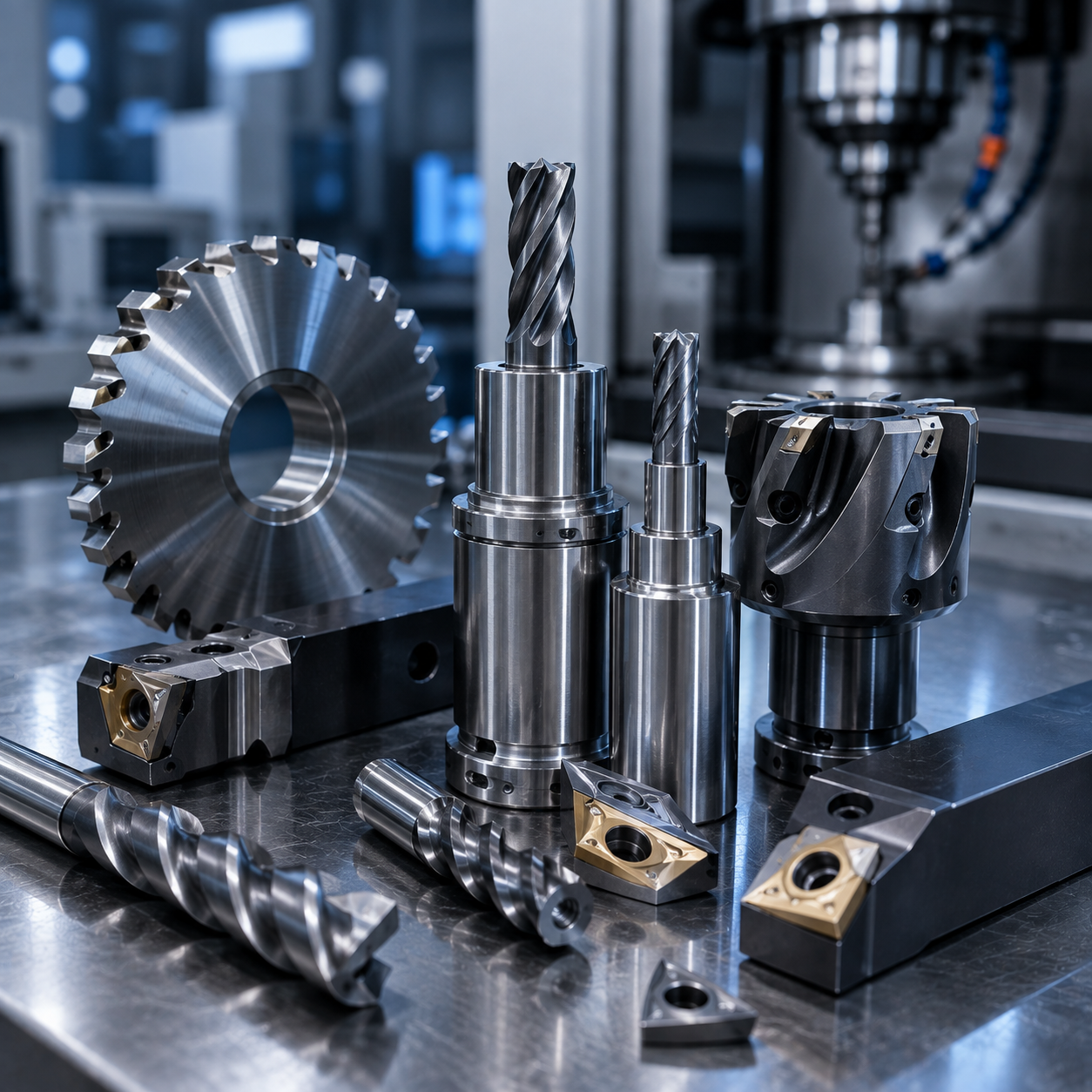
Tooling Edge Preparation and Precision Finishing Solutions
Nagel Precision provides advanced tooling edge preparation, honing and precision surface finishing technologies for manufacturers of cutting tools, inserts, drills, milling tools, reamers and other precision tooling.
Nagel Precision provides advanced tooling edge preparation, honing and precision surface finishing technologies for manufacturers of cutting tools, inserts, drills, milling tools, reamers and other precision tooling.
Tooling Edge Preparation and Precision Finishing Solutions
Nagel Precision provides advanced tooling edge preparation, honing and precision surface finishing technologies for manufacturers of cutting tools, inserts, drills, milling tools, reamers and other precision tooling. By controlling cutting-edge geometry and surface condition at the microscopic level, manufacturers can produce tools engineered for greater consistency, predictable cutting behavior and improved performance.
A freshly ground cutting edge is not necessarily a finished cutting edge. Grinding can leave microscopic burrs, irregularities and sharp transitions that affect how forces and heat are distributed during machining. Controlled cutting tool edge preparation modifies these areas to create a defined edge geometry appropriate for the tool material, workpiece and machining application.
Nagel applies its expertise in precision finishing, abrasives, tooling and process engineering to help manufacturers create repeatable edge preparation processes where the final microns can influence tool performance.
1. Cutting Tool Edge Preparation
The cutting edge is the point where the tool, workpiece, cutting forces and heat come together. Small variations in edge geometry can therefore produce significant differences in machining performance.
Cutting tool edge preparation creates a controlled transition between the tool’s rake face and flank rather than leaving the edge entirely dependent on the grinding operation.
Depending on the cutting application, manufacturers may require a defined edge radius, controlled hone, chamfer or combination geometry.
A properly engineered edge preparation process can help manufacturers pursue:
- Consistent cutting-edge geometry
- Removal of microscopic burrs
- Reduced edge irregularities
- Improved edge stability
- More predictable cutting behavior
- Improved resistance to premature chipping
- Greater tool-to-tool consistency
- Repeatable production quality
Rather than simply making an edge smoother, precision edge preparation allows the cutting edge itself to become an engineered feature of the finished tool.
2. Carbide Inserts & Indexable Cutting Tools
Carbide inserts are used throughout high-volume turning, milling, drilling and other machining operations where cutting performance and tool consistency directly affect manufacturing productivity.
After pressing, sintering and grinding, the insert’s cutting edges may require additional preparation to create the geometry intended for the machining application.
Controlled edge preparation can be particularly important because an excessively sharp edge may be vulnerable to microscopic chipping, while excessive edge rounding can increase cutting forces and alter machining behavior.
The objective is to produce the appropriate edge geometry for the specific insert and application.
Nagel precision finishing technologies can help manufacturers pursue:
- Controlled edge radii
- Consistent edge geometry
- Reduced microscopic defects
- Improved edge stability
- Uniform preparation around the insert
- Improved tool-to-tool repeatability
- Controlled surface characteristics
- Production-ready finishing processes
For manufacturers producing large quantities of carbide inserts, process repeatability can be just as important as achieving the desired geometry on a single tool.
3. Drills, End Mills & Rotary Cutting Tools
Rotary cutting tools contain multiple cutting edges that must work together as the tool rotates at potentially very high speeds.
Drills, end mills, milling cutters, reamers and other rotary tools can benefit from controlled edge preparation designed around their geometry and intended cutting application.
Microscopic inconsistencies between cutting edges can affect load distribution, chip formation and wear behavior. Precision edge preparation provides manufacturers with another level of control after the primary grinding operation.
Depending on the tool design, edge preparation can help provide:
- Consistent cutting edges
- Improved edge strength
- Reduced microscopic chipping
- Controlled edge radii
- Improved cutting-edge uniformity
- Consistent flute-to-flute preparation
- Improved production repeatability
- Predictable tool performance
As cutting speeds increase and manufacturers machine increasingly difficult materials, controlling the geometry of each cutting edge becomes increasingly important.
4. PCD, CBN & Advanced Cutting Tool Materials
Modern manufacturing increasingly relies on advanced cutting materials engineered for applications where conventional tooling may not provide sufficient wear resistance or cutting performance.
These materials include polycrystalline diamond (PCD), cubic boron nitride (CBN), carbide and other advanced tool materials used for demanding machining operations.
Their hardness and wear resistance make them highly effective cutting materials, but those same properties create significant challenges during tool manufacturing and finishing.
Nagel’s expertise in precision abrasives and controlled finishing provides a foundation for developing processes around the specific combination of tool material, cutting-edge geometry and required surface condition.
Depending on the application, precision finishing can help manufacturers achieve:
- Controlled edge geometry
- Reduced microscopic irregularities
- Improved edge consistency
- Repeatable material removal
- Improved cutting-edge stability
- Consistent surface characteristics
- Tool-to-tool repeatability
- Controlled production processes
For advanced cutting tools, the objective is not simply to remove material. It is to remove the correct amount of material in a controlled manner without compromising the geometry required for the cutting application.
5. Edge Radius, Chamfer & Cutting-Edge Geometry Control
There is no single ideal cutting-edge geometry for every machining operation.
Different combinations of tool material, workpiece material, cutting speed, feed rate, depth of cut and machining strategy place different demands on the cutting edge.
Some applications may require a small controlled radius. Others may benefit from a larger hone, chamfered edge or more complex combination geometry.
This makes edge preparation a process-engineering challenge rather than simply a polishing operation.
Precision edge preparation can be developed to control:
- Edge radius
- Edge symmetry
- Chamfer geometry
- Edge transitions
- Cutting-edge consistency
- Rake-face transitions
- Flank-face transitions
- Microgeometry
By engineering these characteristics into the tool, manufacturers can create cutting edges optimized for specific machining requirements rather than relying solely on the condition produced by grinding.
6. Tool Surface Finishing Before Coating
Cutting tool performance is influenced not only by the edge itself but also by the condition of the surfaces surrounding that edge.
Many modern cutting tools receive advanced coatings designed to improve wear resistance, reduce friction or increase performance when machining difficult materials.
Before coating, manufacturers may need to address grinding marks, microscopic burrs, surface irregularities and edge inconsistencies remaining from earlier manufacturing operations.
Controlled surface and edge preparation can create a more consistent tool condition prior to subsequent processing.
Potential manufacturing objectives include:
- Removal of microscopic burrs
- Controlled edge preparation
- Reduced surface irregularities
- Improved surface consistency
- Repeatable pre-coating condition
- Improved edge uniformity
- Controlled tool microgeometry
- Consistent batch-to-batch processing
By controlling the condition of the cutting tool before coating, manufacturers can create a more repeatable foundation for subsequent manufacturing operations.
7. Edge Preparation for Difficult-to-Machine Materials
The growth of aerospace, medical, energy and advanced manufacturing has increased demand for cutting tools capable of machining challenging workpiece materials.
Materials such as titanium alloys, nickel-based superalloys, hardened steels, stainless steels and other high-strength materials can place enormous mechanical and thermal loads on the cutting edge.
In these applications, cutting-edge geometry becomes especially important.
An edge that is too sharp may be susceptible to localized damage or chipping. An edge that is too heavily rounded may generate excessive forces or heat. The appropriate preparation depends on the interaction between the cutting tool and workpiece material.
Precision edge preparation allows tool manufacturers to develop cutting edges around the requirements of specific machining applications.
This can help manufacturers pursue:
- Improved edge stability
- Reduced premature edge failure
- Controlled cutting forces
- More predictable wear behavior
- Consistent machining performance
- Improved tool repeatability
- Application-specific edge geometry
- Greater process reliability
This creates opportunities for tool manufacturers to engineer different edge preparations for aerospace, medical, automotive, die and mold, energy and other demanding machining markets.
8. Automated Tool Edge Preparation & Production Consistency
Producing an excellent cutting edge on one tool is very different from producing that same edge repeatedly across hundreds of thousands of tools.
For cutting tool manufacturers, process consistency and automation are therefore critical parts of edge preparation.
Manual processes can introduce operator-dependent variation. A controlled production process provides manufacturers with a more repeatable method for achieving the desired edge condition from tool to tool and batch to batch.
Nagel’s experience in precision manufacturing, automation, tooling, abrasives and process development can help manufacturers develop finishing processes around their production requirements.
Depending on the application, automated edge preparation can help provide:
- Repeatable cutting-edge geometry
- Reduced operator dependency
- Consistent tool-to-tool quality
- Controlled processing parameters
- Improved production efficiency
- Reduced process variation
- Scalable manufacturing capacity
- Reliable high-volume production
The objective is not simply automation for its own sake. It is to create a controlled, measurable and repeatable finishing process capable of producing the required cutting-edge characteristics throughout production.
Precision Edge Preparation for Cutting Tool Manufacturing
The performance of a cutting tool can ultimately depend on an extremely small area — the microscopic region where the cutting edge meets the workpiece.
Grinding establishes the basic tool geometry. Precision edge preparation helps engineer the final cutting edge for its intended application.
Nagel Precision brings decades of experience in precision finishing, abrasives, tooling, machine technology, automation and process engineering to demanding manufacturing applications where microscopic surface and geometry control matter.
From carbide inserts and rotary cutting tools to PCD, CBN and specialized tooling for difficult-to-machine materials, Nagel works with manufacturers to develop controlled finishing processes around the tool, material and required edge characteristics.
Whether the objective is improving edge consistency, controlling a defined radius, preparing tools for subsequent processing or moving from manual finishing to automated production, Nagel can help transform edge preparation into a repeatable manufacturing process.
Nagel Precision helps cutting tool manufacturers control the final microns of the cutting edge — where precision manufacturing becomes cutting performance.
* Indicates A Required Field